
⚠️ Pre-release article. The Galaxy Z Fold 8 has not been officially announced by Samsung as of May 16, 2026. Every Z Fold 8 spec in this article is based on credible supply-chain leaks and industry reporting. Confidence labels mark each claim. Final specs confirmed at Galaxy Unpacked London, July 22, 2026.
OdinCase is the only online store in the world that specializes exclusively in Samsung Galaxy cases and accessories. We've had precision-fit cases ready from Day 1 of every Z Fold generation since the Z Fold 3 — and the Z Fold 8 is no different. Whether you upgrade or keep your Z Fold 7, you're covered. This comparison is built on the most current leak data available as of May 16, 2026, from SamMobile, PhoneArena, NotebookCheck, Android Central, Android Authority, and 9to5Google.

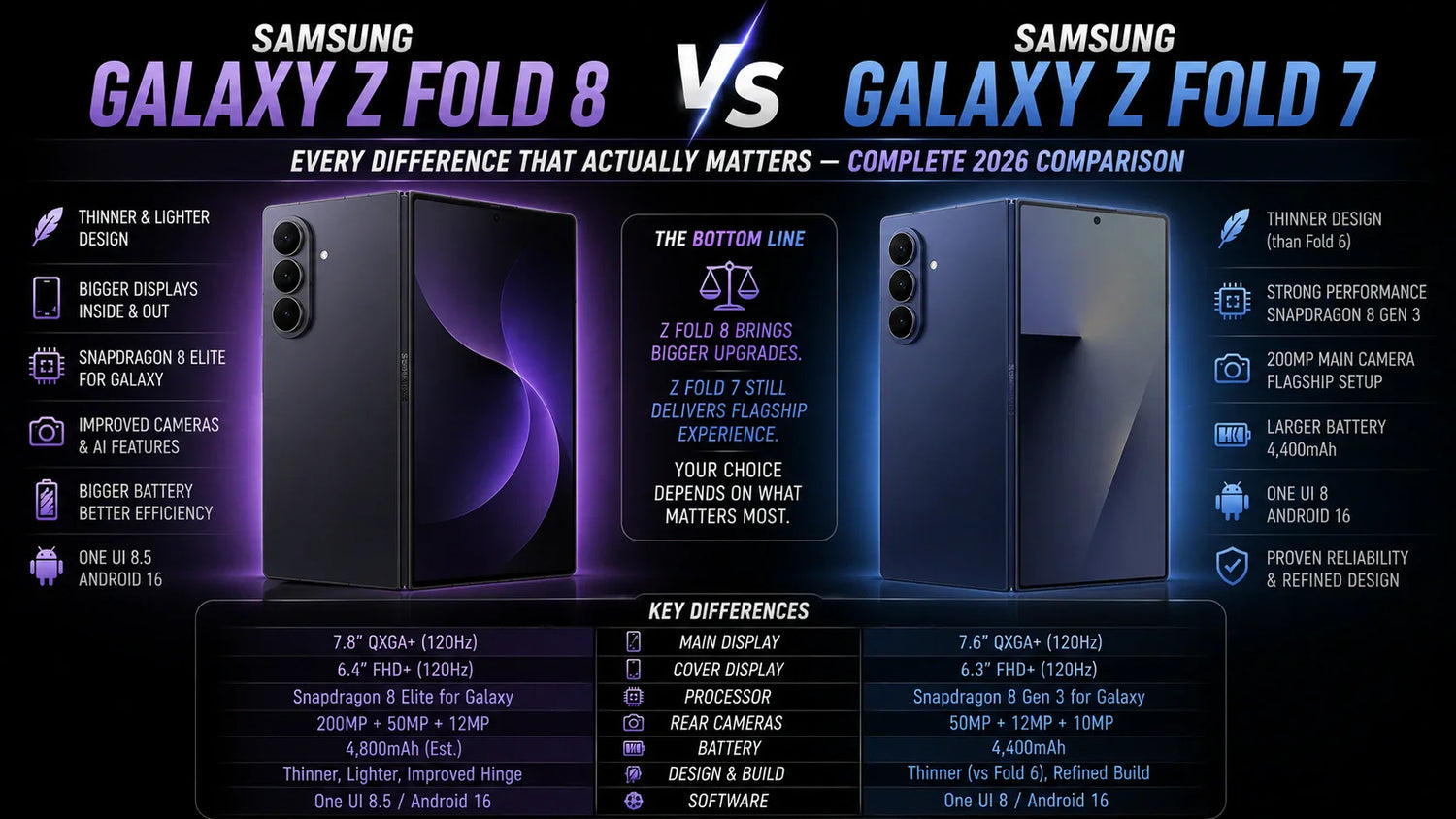
Side-by-Side: Z Fold 8 vs Z Fold 7 — All Known Specs
| Specification | Galaxy Z Fold 8 (2026) | Galaxy Z Fold 7 (2025) |
|---|---|---|
| Launch date | ~July 22, 2026 🔵 | July 9, 2025 ✅ |
| Starting price | $1,999 🔵 | $1,999 ✅ |
| 512GB price | ▲ +$80 $2,199 🔵 | $2,119 ✅ |
| 1TB price | ▲ +$80 $2,499 🔵 | $2,419 ✅ |
| Chipset | Snapdragon 8 Elite Gen 5 🔵 | Snapdragon 8 Elite for Galaxy ✅ |
| RAM | 12GB / 16GB (1TB) 🔵 | 12GB / 16GB (1TB) ✅ |
| Storage tiers | 256 / 512 / 1TB 🔵 | 256 / 512 / 1TB ✅ |
| Inner display size | 8.0-inch AMOLED 2x 🔵 | 8.0-inch AMOLED 2x ✅ |
| Inner display refresh | 1–120Hz LTPO 🔵 | 1–120Hz LTPO ✅ |
| Display crease | Dual-UTG + laser plate 🔵 IMPROVED | Standard UTG ✅ |
| Cover display size | 6.5-inch 🔵 WIDER | 6.2-inch ✅ |
| Cover display type | FHD+ AMOLED 120Hz 🔵 | FHD+ AMOLED 120Hz ✅ |
| Folded (H × W × D) | 158.4 × 72.8 × 9.0mm 🔵 | 158.4 × 67.1 × 8.9mm ✅ |
| Unfolded thickness | ~4.5mm real-world 🔵 | ~4.5mm real-world ✅ |
| Weight | Lighter 🔵 ↓ | 215g ✅ |
| Backplate material | CFRP likely 🟡 POSSIBLE DOWNGRADE | Titanium ✅ |
| Main camera | 200MP (1/1.3") 🔵 | 200MP ✅ |
| Ultrawide camera | 50MP 🔵 ↑ MAJOR | 12MP ✅ |
| Telephoto | 10MP 3x optical 🔵 | 10MP 3x optical ✅ |
| Cover selfie camera | 10MP, 2.5mm hole 🔵 SMALLER NOTCH | 10MP, 3.7mm hole ✅ |
| Inner selfie camera | Under-display 🔵 | Under-display ✅ |
| Battery | 5,000mAh 🔵 ↑ +13.6% | 4,400mAh ✅ |
| Wired charging | 45W 🟡 ↑ +80% | 25W ✅ |
| Wireless charging | 15W Qi2 🔵 | 15W Qi2 ✅ |
| USB-C | 3.2 Gen 2 🔵 ↑ | 3.2 Gen 1 ✅ |
| S Pen support | Rumored return 🟡 | Not supported ✅ |
| Water resistance | IP48 🔵 | IP48 ✅ |
| Foreign Material Detection | Yes — new feature 🔵 | No |
| OS at launch | Android 17 / One UI 9 🔵 | Android 16 / One UI 8 ✅ |
| Software support | 7 years ✅ | 7 years ✅ |
✅ Confirmed 🔵 Credible Leak 🟡 Rumor/Unconfirmed — All Z Fold 8 specs are pre-release leaks subject to change at July 22 announcement.
The 8 Differences That Actually Matter — Ranked by Daily Impact
Not all upgrades are equal. Here is every meaningful difference between the Z Fold 8 and Z Fold 7, ranked by how much you'll actually feel them in daily use — with a verdict on whether each change justifies anything.
This is not an incremental upgrade — it is a generational jump. The Galaxy Z Fold 7's 12MP ultrawide was the single weakest element of an otherwise strong camera system. In good light it was acceptable. In mixed or challenging light, the gap between the 200MP main sensor and the 12MP ultrawide was visible to anyone who knew what they were looking at. Against competitors like the Oppo Find N5 (which scores full-resolution ultrawide sensors), the Z Fold 7's ultrawide was an obvious weakness Samsung had let linger too long.
The Z Fold 8's 50MP ultrawide matches the Galaxy S26 Ultra's ultrawide resolution spec-for-spec. This is Samsung finally bringing the Fold camera in line with its flagship slab lineup. In practical terms: landscape shots, architectural photography, group photos, and any wide-scene capture will look dramatically better. The 50MP sensor also enables 8K ultrawide video recording — a capability the 12MP sensor physically couldn't support.
The main camera stays at 200MP (same resolution as Z Fold 7, same 1/1.3-inch sensor as S26 Ultra). The telephoto stays at 10MP 3x. The improvement is entirely in the ultrawide — but that was exactly the right place to focus it.
⬆️ MAJOR UPGRADE — The single biggest camera improvement in Z Fold historyThe Galaxy Z Fold 3 launched in August 2021 with a 4,400mAh battery. Every subsequent Fold — the 4, the 5, the 6, and the 7 — used the same 4,400mAh cell. Five consecutive generations with no capacity change, across which Samsung added brighter displays, faster processors, AI workloads, and larger cover screens — all of which draw more power from the same battery.
The Z Fold 8's 5,000mAh represents a 13.6% increase — meaningful rather than transformative, but the first meaningful battery improvement the Z Fold line has received in years. Combined with the Snapdragon 8 Elite Gen 5's improved efficiency, real-world battery life should be noticeably better on a heavy productivity day. The users who experience this most are the exact target audience: people who unfold the device regularly, run DeX sessions, and ask the Z Fold to do more than a standard phone.
The charging upgrade (25W → 45W, if confirmed) is arguably the bigger quality-of-life change. 🟡 A 30-minute charge on the Z Fold 7 delivers approximately 35% battery. The same 30 minutes on the Z Fold 8 should deliver approximately 55–60%. For quick top-ups before leaving the house or between meetings, this is a tangible daily improvement. The Z Fold 7 at 25W in 2025 was already behind the Galaxy S25 Ultra at 45W — in 2026, holding at 25W would have been genuinely embarrassing. The Z Fold 8 finally closes this gap.
⬆️ MAJOR UPGRADE — First battery increase in 5 generations. Combined with 45W charging: the most impactful quality-of-life change in the Z Fold 8.Samsung Display previewed a crease-free foldable OLED panel at CES 2026 in Las Vegas — placing it next to an older panel in a dedicated "Crease Test" area. The visual improvement was significant enough that multiple technology journalists described it as "near-invisible" under normal viewing conditions, though faintly detectable by touch on close examination.
The technology is a dual-layer UTG (Ultra Thin Glass) structure combined with a laser-drilled metal support plate at the hinge zone. By precision-drilling micro-perforations into the support plate, the folding area bends more naturally across a wider radius — distributing the stress that creates the crease over a larger surface area, making it shallower and less visible. Samsung claims approximately 20% crease reduction versus the Z Fold 7.
Context matters here: the Z Fold 7 already had the best crease of any Samsung Fold — meaningfully better than the Z Fold 6. The Z Fold 8 won't eliminate the crease entirely. But for users who have found the crease objectionable on every Fold they've owned, the Z Fold 8 may be the first generation where it genuinely stops being an issue during normal use. Early prototype reports from leakers who have handled Z Fold 8 units describe the crease as "nearly imperceptible under normal viewing angles."
⬆️ MAJOR IMPROVEMENT — Not elimination, but the biggest single-generation crease reduction since Samsung began the series.Samsung removed S Pen support from the Galaxy Z Fold 7 — the first time in the Fold's history the feature was absent entirely. The reason: removing the EMR digitizer layer from both sides of the display saved 0.6mm of thickness, allowing the Z Fold 7 to achieve its landmark 4.2mm official unfolded profile. For Samsung chasing Chinese competitors on thinness, the trade-off made sense technically. For the S Pen users who had built workflows around Fold-compatible note-taking and annotation, it was a significant loss.
The Z Fold 8's connection to S Pen is linked to its backplate material choice. Samsung used titanium on the Z Fold 7 — a material that isn't compatible with the EMR digitizer required for S Pen. A return to CFRP (carbon fiber-reinforced plastic, used on Folds 3 through 6) may enable digitizer reintegration. However, Android Central reports that the Z Fold 8 "isn't expected to bring the feature back" in the same form — and no supply-chain source has confirmed a built-in S Pen slot as of May 2026.
The most credible current picture: S Pen accessory compatibility (writing on the display with an external S Pen) may return, but a built-in storage silo in the device body is not confirmed. The Z Fold 8 Wide is the more likely candidate for meaningful S Pen reintegration, given its slightly thicker folded profile (9.8mm vs Z Fold 8's 9.0mm) which provides more engineering space. If S Pen returns on either model, cases with dedicated S Pen holders become essential — and OdinCase will have them at launch.
🟡 WATCH THIS SPACE — Rumored but unconfirmed. Could be the most important feature for former S Pen users. Confirmed at July 22 Unpacked.The Galaxy Z Fold 8 is 5.7mm wider when folded than the Z Fold 7. This is not a trivial difference — 72.8mm is approaching the width of a standard slab flagship phone, which means the Z Fold 8 in its folded state will feel more like a conventional phone in the hand and less like the narrow, almost-too-thin form factor of the Z Fold 7. For users who found the Z Fold 7's narrow folded width limiting for one-handed typing, this is a genuine ergonomic improvement.
The wider folded body also means a wider cover display (6.5-inch vs 6.2-inch on the Z Fold 7) — more usable cover screen real estate for one-handed use without unfolding. Samsung has been steadily improving the cover display experience across generations, and the width increase on the Z Fold 8 gives the 6.5-inch cover screen proportions closer to a standard flagship phone.
The trade-off: a wider folded device is less compact in a jacket pocket, and Z Fold 7 cases will not fit the Z Fold 8. The dimensional difference (72.8mm vs 67.1mm) is large enough that case compatibility between generations is impossible. Anyone upgrading from Z Fold 7 to Z Fold 8 needs new cases. OdinCase will have a full Z Fold 8 collection ready at launch.
🔵 NOTABLE CHANGE — Better one-handed ergonomics and larger cover screen. Also means your Z Fold 7 cases won't transfer.Ice Universe — one of the most reliable Samsung leakers — shared side-by-side comparisons of the Z Fold 7 and Z Fold 8 cover display camera holes. The reduction from 3.7mm to 2.5mm is a 32% decrease in hole diameter — visible enough to be noticeable in daily use on the cover display. Samsung is using a new optical technology to achieve this miniaturization while maintaining 10MP image quality.
In practical terms: the smaller hole-punch is less distracting during cover display use, which is where Z Fold owners spend most of their folded-mode time. It's also a signal that Samsung Display is continuing to push miniaturization toward an eventual under-display camera on the cover screen as well — though that's not confirmed for the Z Fold 8.
🔵 NOTABLE — Visible daily improvement to cover display experience. Not transformative but appreciated.This is the most controversial potential change in the Z Fold 8 — and the one that feels most like a step backward. The Galaxy Z Fold 7's titanium backplate was a meaningful premium material upgrade that contributed to its excellent rigidity and premium in-hand feel. Samsung is reportedly considering switching back to carbon fiber-reinforced plastic (CFRP) for the Z Fold 8's backplate — the same material used on the Z Fold 3 through Z Fold 6.
The reason is supply chain, not engineering preference. According to The Elec, Samsung sourced titanium from supply chains with significant Chinese involvement — and ongoing US-China trade tensions are creating supply uncertainty. CFRP is more geopolitically accessible and has a secondary benefit: it's compatible with the EMR digitizer layer needed for S Pen integration, which titanium is not. If Samsung uses CFRP and brings S Pen back, the material trade-off has a functional justification.
PhoneArena noted that Samsung is still "exploring its options" and no final decision has been made. It's possible the Z Fold 8 retains titanium in some form. The honest assessment: CFRP is not bad — Samsung used it successfully across four Fold generations. But it does not feel as premium in the hand as titanium, and for a $1,999 device, material quality matters for the ownership experience.
⚠️ POSSIBLE DOWNGRADE — Not confirmed, but supply chain constraints make CFRP the likely outcome. Watch for official confirmation at Unpacked.Foreign Material Detection is a new One UI 9 software feature that uses the Z Fold 8's sensors to detect when debris — sand, pocket lint, grit — has become trapped between the display panels, and alerts the user before damage can occur. This addresses one of the most common and most invisible ways foldable inner displays get damaged: a particle enters the hinge gap during folded carry, and is dragged across the UTG inner display with each open-close cycle, creating micro-scratches that accumulate over time.
The feature doesn't prevent debris from entering — a case with hinge coverage is still the most effective prevention. But for Z Fold owners who have been anxious about this failure mode (and anyone who has ever found debris on their inner display will understand this anxiety), getting a software alert before damage is done is a genuine quality-of-life addition.
🟡 THOUGHTFUL ADDITION — Low-effort, high-value software feature. Won't change your buying decision but will be appreciated daily.What the Z Fold 8 Does NOT Change — And Why That Matters
Understanding what Samsung left unchanged is as important as what changed. These are the elements where the Z Fold 7 was already excellent — and the Z Fold 8 has no reason to fix what isn't broken.
Inner Display Size — Still 8.0 Inches
The Z Fold 7 made the jump from 7.6 inches (Folds 3–6) to 8.0 inches. The Z Fold 8 stays at 8.0 inches. If you were hoping for an 8.5-inch or 9-inch display, the answer is the Galaxy Z Fold 8 Wide with its 4:3 landscape inner display — not the standard Z Fold 8. The 8.0-inch portrait display with 120Hz LTPO remains the standard Fold format for this generation.
Chipset — Snapdragon 8 Elite Gen 5 (Same Platform as S26 Ultra)
The Z Fold 7 launched with Snapdragon 8 Elite for Galaxy — the best available at the time. The Z Fold 8 gets Snapdragon 8 Elite Gen 5, the same chip powering the Galaxy S26 Ultra. 🔵 In practice, the generational performance jump between Snapdragon 8 Elite and Gen 5 is meaningful for AI processing and sustained multi-window workloads, but not the kind of difference that drives an upgrade decision on its own.
Water Resistance — IP48
The Z Fold 7's IP48 rating carries over to the Z Fold 8. IP48 means resistance to objects 1mm and larger, and water immersion up to 1.5m for 30 minutes. It is not the IPX8 of standard flagship phones — dust ingress via the hinge gap is still a concern that cases with hinge coverage address directly.
Form Factor — Same Portrait Book-Style Fold
If you want the new landscape 4:3 inner display, that is the Galaxy Z Fold 8 Wide — a separate device with different dimensions, different cases, and a different buyer profile. The standard Z Fold 8 is the same portrait book-style foldable that has defined the series since 2019, refined rather than reimagined.
Software Support — 7 Years
Both the Z Fold 7 and Z Fold 8 receive 7 years of OS and security updates. The Z Fold 8 launches with Android 17 / One UI 9 and will receive updates through approximately 2033. ✅ Confirmed Pattern
Case Compatibility — Z Fold 7 Cases Will NOT Fit the Z Fold 8
⚠️ Z Fold 7 cases are incompatible with the Z Fold 8. The Z Fold 8 is 5.7mm wider when folded (72.8mm vs 67.1mm) with a different camera module positioning. No Z Fold 7 case will align correctly on a Z Fold 8. If you upgrade to Z Fold 8, you need new cases from day one.
This is not unusual — Z Fold dimensions have changed across every generation. But for Z Fold 7 owners considering the upgrade, the case investment is part of the total cost calculation. The good news: OdinCase will have a complete Z Fold 8 case collection available at launch on July 22, 2026, across every category: MagSafe armor, leather, S Pen holders (if S Pen returns), wallet, clear, rugged, frosted, carbon fiber, and keyboard productivity cases.
💡 The Real Upgrade Cost Math for Z Fold 7 Owners
Sticker price: $1,999 for the base Z Fold 8
Z Fold 7 trade-in value (estimated July 2026): $800–$1,200 with Samsung direct promotions. Carrier deals (AT&T, T-Mobile, Verizon) can push effective trade-in value to $1,000+ with installment credits. Actual out-of-pocket cost for a Z Fold 7 owner upgrading at launch: $800–$1,200 in most scenarios.
New cases: Budget $40–$100 for a new Z Fold 8 case. Z Fold 7 cases cannot transfer.
The honest question: Does the ultrawide camera (12MP → 50MP), the battery (4,400 → 5,000mAh), the charging (25W → 45W), and the reduced crease justify the net upgrade cost to you personally? For daily ultrawide users and people whose Z Fold 7 consistently runs low by evening — the answer is likely yes. For most other Z Fold 7 owners — probably not.
Who Should Upgrade to the Z Fold 8 — and Who Should Wait
- You own a Z Fold 5 or Z Fold 6 — multi-gen camera + battery + crease jump is meaningful
- The ultrawide camera is a daily use case you find limiting on your current device
- You charge during the day and the 25W / 4,400mAh combination regularly leaves you low by evening
- The display crease has bothered you since day one and you've never fully accepted it
- You want or need S Pen support that was removed from the Z Fold 7
- You're buying your first Z Fold and the Z Fold 8 launches before you need one
- You want the latest device before Apple's iPhone Fold arrives in September
- You've had the Z Fold 7 for under 12 months and it's working well for you
- You don't use the ultrawide camera regularly enough to notice the resolution difference
- Your Z Fold 7 battery makes it through the day consistently
- The design is unchanged — Z Fold 8 looks nearly identical to Z Fold 7
- You want to see the Z Fold 8 Wide first before deciding which model suits you
- You want to compare Z Fold 8 against iPhone Fold once Apple's device launches in September
- Trade-in value + case replacement cost doesn't justify the net upgrade cost at this moment

Leave a comment
This site is protected by hCaptcha and the hCaptcha Privacy Policy and Terms of Service apply.