
⚠️ Pre-release comparison. Neither device has been officially announced as of May 18, 2026. All Z Fold 8 and Z Fold 8 Wide specifications are based on credible leaks. Every claim is confidence-labeled. Final specs confirmed at Galaxy Unpacked London, July 22, 2026.
OdinCase is the only online store in the world that specializes exclusively in Samsung Galaxy cases and accessories. We've had precision-engineered cases ready from day one of every Z Fold generation — and the Z Fold 8 and Z Fold 8 Wide are no different. Separate case collections for each device launch on July 22, 2026 — because they are completely different shapes that require completely different cases. This comparison is built on the most current leak data available, from SamMobile, PhoneArena, AndroidHeadlines, Geeky Gadgets, and Tom's Guide.
The Decision Samsung Has Never Made You Make Before
Since the original Galaxy Fold launched in 2019, Samsung's strategy was simple: one book-style foldable per year. You got the Z Fold — tall, narrow, portrait-first — and you could take it or leave it. If you wanted a different shape, you bought a Flip or waited for the TriFold.
2026 changes that. For the first time, Samsung is simultaneously launching two book-style foldables at the same price point, targeting fundamentally different users. The Galaxy Z Fold 8 continues the established formula, refined across eight generations. The Galaxy Z Fold 8 Wide introduces a form factor Samsung has never shipped — wider than it is tall when unfolded, with a near-square 3:4 aspect ratio designed for landscape content, split-screen productivity, and one specific external objective: being on sale before Apple's foldable iPhone arrives in September 2026.
🔑 The Three Questions That Determine Your Choice
1. Do you unfold your phone primarily for reading/browsing vertically, or for productivity/media in landscape? Portrait-dominant use → Z Fold 8 standard. Landscape-dominant use → Z Fold 8 Wide.
2. How important is camera zoom to you? The standard Z Fold 8 has a 10MP 3x telephoto. The Z Fold 8 Wide does not. If zoom photography matters — even occasionally — the standard Fold 8 is the correct choice.
3. Do you want the largest possible cover screen for one-handed use when folded? The Z Fold 8's 6.5-inch cover display functions like a full flagship phone when folded. The Z Fold 8 Wide's 5.4-inch cover screen is proportionally narrower and shorter. For users who spend significant time on the cover screen, this gap is felt daily.
Form Factor: Two Shapes, Two Different Devices
The most important difference between these two devices isn't a spec — it's a shape. Understanding the physical proportions is the prerequisite for everything that follows.
PORTRAIT
6:5
LANDSCAPE
3:4
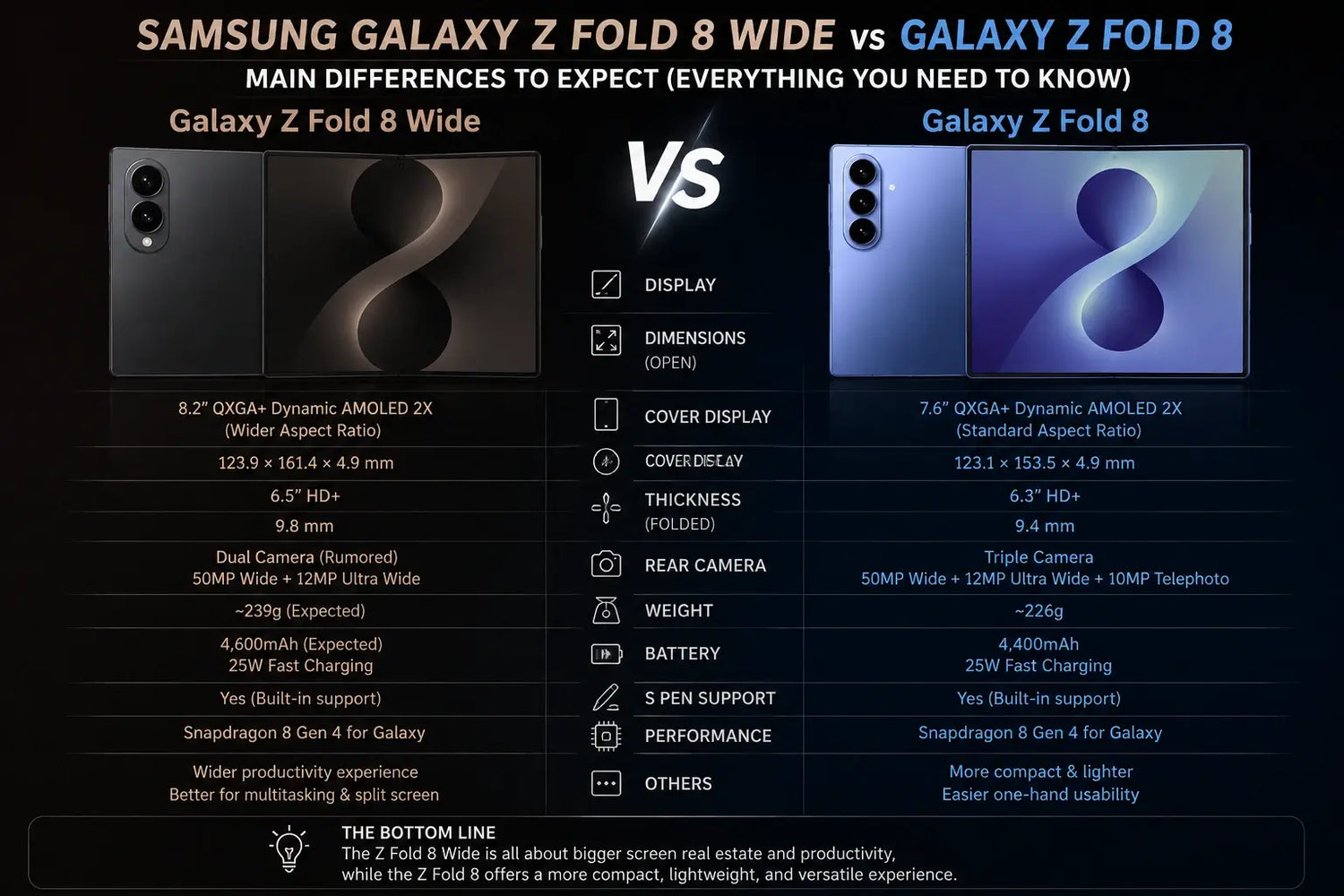
The Galaxy Z Fold 8 Wide is significantly larger than the standard Galaxy Z Fold 8 when unfolded, with a 3:4 aspect ratio that is much closer to a traditional tablet than any previous Samsung foldable. In terms of raw dimensions, the Galaxy Z Fold 8 unfolded measures 158.4 × 143.2 × 4.5mm, while the Galaxy Z Fold 8 Wide unfolded is 123.9 × 161.4 × 4.9mm.
Translated into human terms: the Z Fold 8 Wide is 18.2mm wider than the standard Fold 8, and 34.5mm shorter. When you open it, you're looking at something that's wider than it is tall — a completely different cognitive experience from the traditional book-style Fold. The standard Fold 8 opens to a tall, book-like rectangle that you hold vertically. The Wide opens to a landscape-first rectangle that you naturally orient horizontally — like holding a small tablet sideways.
📐 Why the 3:4 Aspect Ratio Is a Fundamental Shift
Every Galaxy Z Fold since the original 2019 model has had a tall, portrait-biased inner display. Apps designed for phones extend vertically; the extra width is used for split-screen panels that run tall and narrow. The 3:4 inner display of the Z Fold 8 Wide changes this entirely: app windows in split-screen mode are wider, closer to a desktop aspect ratio. Landscape video plays without letterboxing. Web pages render more like a laptop browser. Spreadsheets and documents show more columns. This is not a slight variant — it is a genuinely different device experience that suits different workflows.
Side-by-Side: Z Fold 8 vs Z Fold 8 Wide — All Known Specs
| Specification | Galaxy Z Fold 8 | Galaxy Z Fold 8 Wide |
|---|---|---|
| Codename | SM-F976 ✅ | SM-F971 ✅ |
| Launch event | Galaxy Unpacked London · July 22, 2026 🔵 | |
| Starting price (US) | ~$1,999 🔵 | ~$1,999–$2,199 🟡 |
| Chipset | Snapdragon 8 Elite Gen 5 for Galaxy 🔵 | |
| RAM | 12GB / 16GB (1TB) 🔵 | 12GB 🟡 |
| Storage | 256GB / 512GB / 1TB 🔵 | 256GB / 512GB 🟡 |
| Unfolded (H×W×D) | 158.4 × 143.2 × 4.5mm 🔵 | 123.9 × 161.4 × 4.9mm 🔵 |
| Folded (H×W×D) | 158.4 × 72.8 × 9.0mm 🔵 | 123.9 × 82.2 × 9.8mm 🔵 |
| Inner display size | 8.0-inch LARGER 🔵 | ~7.6-inch 🔵 |
| Inner display type | Dynamic AMOLED 2x, 120Hz 🔵 | AMOLED, 120Hz 🔵 |
| Inner aspect ratio | ~6:5 (portrait) 🔵 | 3:4 (landscape) UNIQUE 🔵 |
| Inner selfie camera | Under-display 10MP 🔵 | Not present (no UDC) 🔵 MISSING |
| Crease reduction | Dual-UTG + laser plate 🔵 | Improved UTG 🔵 |
| Cover display size | 6.5-inch LARGER 🔵 | 5.4-inch 🔵 |
| Cover selfie | 10MP, 2.5mm hole 🔵 | 10MP 🔵 |
| Main camera | 200MP (1/1.3") OIS HIGHER RES 🔵 | 50MP 🔵 |
| Ultrawide camera | 50MP 🔵 | 50MP 🔵 |
| Telephoto camera | 10MP 3x optical HAS ZOOM 🔵 | None — dual camera only NO ZOOM 🔵 |
| Battery | 5,000mAh LARGER 🔵 | 4,800mAh 🔵 |
| Wired charging | ~45W 🟡 | ~45W 🟡 |
| Wireless charging | 15W Qi2 🔵 | 15W Qi2 🔵 |
| Unfolded thickness | 4.5mm (thinner) 🔵 | 4.9mm 🔵 |
| Folded thickness | 9.0mm (thinner) 🔵 | 9.8mm 🔵 |
| Frame material | Armor Aluminum 🔵 | Armor Aluminum 🔵 |
| Water resistance | IP48 🔵 | |
| S Pen (accessory) | Rumored return 🟡 | Possible (thicker profile) 🟡 |
| Samsung DeX | Both supported 🔵 | |
| Privacy Display | Both expected 🔵 | |
| OS | Android 17 / One UI 9 🔵 | |
| Software support | 7 years ✅ | |
All specifications are pre-release leaks. ✅ Confirmed 🔵 Credible Leak 🟡 Rumor — subject to change at July 22, 2026 Unpacked announcement.
The 7 Differences That Define Which Device Is Right for You
This is the entire comparison in one difference. Every other spec gap flows from this one decision Samsung made when designing the Wide: it opens horizontally, not vertically.
The standard Galaxy Z Fold 8, like every Fold before it, opens to a tall rectangle. When you hold it in your hands and unfold it, you're looking at a display that's taller than it is wide — approximately 158mm tall by 143mm wide. Apps designed for smartphones extend naturally in this orientation. The experience is a phone that unfolds into something closer to a digital magazine or a professional document viewer. The additional width relative to a standard phone gives you split-screen panels, but they're relatively narrow side-by-side columns.
The Z Fold 8 Wide inverts this. When you unfold it, you're holding something 161mm wide and only 124mm tall — a landscape-first device with proportions that match an iPad Mini turned sideways. Split-screen apps now have genuinely usable widths: two full-width panels side-by-side instead of two narrow columns. Landscape video plays without black bars at top and bottom. Web pages render like a laptop browser. When you connect a Bluetooth keyboard for Samsung DeX, the display proportions feel like a laptop screen, not a stretched phone.
AndroidHeadlines captured this precisely: Samsung's Z Fold 8 Wide is significantly larger than the standard Galaxy Z Fold 8, with a 3:4 aspect ratio that's much closer to a traditional tablet than any previous Samsung foldable.
The trade-off is equally fundamental. The Z Fold 8 Wide's portrait cover screen is narrower (5.4-inch, 82.2mm wide) than the standard Fold 8's cover screen (6.5-inch, 72.8mm wide when folded). One-handed thumb coverage on the Z Fold 8 Wide's cover screen is constrained by its 82mm width — wider than a standard phone when folded. For users who rely heavily on the cover screen for quick tasks, messages, and calls, the Wide's shorter, wider folded form feels different from a standard phone in the hand.
This is the most concrete hardware trade-off between the two devices — and for camera-focused buyers, it may be decisive on its own. The standard Galaxy Z Fold 8 carries Samsung's most advanced triple-camera system: a 200MP main sensor (the same 1/1.3-inch unit from the Galaxy S26 Ultra), a 50MP ultrawide, and a 10MP telephoto with 3x optical zoom. This is the closest a Z Fold camera has ever come to matching the Galaxy S Ultra's imaging capability.
The Galaxy Z Fold 8 Wide drops the telephoto entirely. The Z Fold 8 Wide omits the 3x telephoto lens, which limits its versatility for photography. The dual-camera system uses a 50MP main sensor (lower resolution than the standard Fold 8's 200MP) and a 50MP ultrawide — a symmetrical dual setup that prioritizes consistency over the standard Fold 8's imaging range.
The reason for the omission is almost certainly structural. The Z Fold 8 Wide's thinner profile requires housing a wider device with a different internal architecture. The triple-camera module of the standard Fold 8 — including the telephoto periscope or folded lens system — physically requires depth that the Wide's design trades against its unique proportions. Samsung chose the form factor over the telephoto.
The practical impact: the standard Z Fold 8 can photograph a subject across a room, a speaker on a stage, a detail on an architectural facade, or a child's face at a park — all without cropping from a 200MP base image. The Z Fold 8 Wide must either crop digitally (from a 50MP base, which is significantly noisier than optical zoom from a dedicated telephoto) or get physically closer. For any user who regularly uses phone zoom — travel photography, events, sports, wildlife, architecture — the standard Fold 8's triple camera is a material daily advantage.
The Wide's 50MP main sensor may deliver excellent results in good light, but it is categorically outgunned by the standard Fold 8's 200MP unit in resolution, low-light capture, and computational flexibility. Geeky Gadgets described the 200MP option as offering "unmatched detail, making it ideal for users who frequently edit or print high-resolution images."
Both the Z Fold 8 and Z Fold 8 Wide are carried in their folded state for most of the day — the Z Fold is a device you unfold when you need the larger display and fold closed for everything else. The cover screen is the display you use for the majority of your daily phone interactions: checking messages, taking calls, reading notifications, browsing social media, using maps, and handling quick tasks that don't justify unfolding.
The standard Z Fold 8's 6.5-inch cover display is, by itself, a flagship-phone-sized screen. At 72.8mm wide (when folded), it is comfortably within one-handed use territory for most adults. Typing on it is natural. Media on it is watchable. It functions as a complete phone in folded mode. Geeky Gadgets confirmed: the Z Fold 8 features a 6.5-inch cover display and an expansive 8-inch inner display, with the larger screen area ideal for users who prioritize multitasking, productivity, or immersive experiences.
The Z Fold 8 Wide's 5.4-inch cover screen is meaningfully smaller — and the device itself is 82.2mm wide when folded, which is wider than most standard flagship phones. The combination of a narrower display on a physically wider body means the Z Fold 8 Wide has screen-to-body constraints that may make one-handed folded use less comfortable, particularly for thumb typing. The shorter height (123.9mm folded vs 158.4mm) is the Wide's saving grace — it fits more naturally in smaller hands and pockets.
This difference compounds across a day of use. If you spend 70% of your Z Fold usage in folded mode — as most users do — the cover screen experience defines the device more than the inner display does. The standard Fold 8's cover screen is the Z Fold 8's strongest daily-use argument over the Wide variant.
The battery difference between the two devices is 200mAh — 5,000mAh vs 4,800mAh — a 4% variance that is unlikely to produce noticeable real-world differences in day-to-day use. The Galaxy Z Fold 8 Wide is equipped with a 4,800mAh battery, providing reliable performance for everyday tasks and moderate usage. The standard Fold 8's 5,000mAh is marginally larger. Since both run the same Snapdragon 8 Elite Gen 5 chip, battery efficiency per use case should be comparable. The 200mAh delta is less significant than the usage pattern difference: the Z Fold 8 Wide's larger open display area — wider but shorter — may draw slightly different power for landscape-heavy use cases like gaming and video.
The thickness difference is more meaningful. The Z Fold 8 Wide folds to 9.8mm — versus the standard Fold 8's 9.0mm. That 0.8mm gap is noticeable in the hand and may affect pocket carry for users sensitive to device thickness. Similarly, unfolded, the Wide is 4.9mm versus the standard's 4.5mm — a difference you'd feel when holding the device open for extended DeX or productivity sessions.
The Wide's additional thickness likely accommodates its different internal architecture: a wider, shorter body with a different hinge geometry requires different engineering compromises. The slight thickness premium may also be connected to S Pen compatibility rumors — the extra 0.4–0.8mm could be the engineering space that enables digitizer reintegration. 🟡
Both the Galaxy Z Fold 8 and Z Fold 8 Wide support Samsung DeX — the desktop-replacement software mode that transforms Samsung foldables into near-laptop computing environments with resizable app windows, a cursor interface, multi-window workspaces, and full productivity application support. The Z TriFold was the first Samsung phone to run DeX on its own display without an external monitor. Both Z Fold 8 models inherit this capability.
But DeX on the two devices is a meaningfully different experience because of their display proportions. On the standard Z Fold 8's 8-inch 6:5 display, DeX windows are constrained by the portrait-biased canvas — applications that expect a wide desktop layout feel slightly cramped, and split-screen panels are narrower than comfortable for side-by-side document work.
On the Z Fold 8 Wide's 3:4 landscape display, DeX works the way it was always meant to. The Galaxy Z Fold 8 Wide's shorter and wider form factor is better suited for multitasking, media consumption and gaming, with its tablet-like design enhancing split-screen functionality, allowing users to run multiple apps simultaneously. Proportions that are 161mm wide and 124mm tall create a canvas that feels genuinely laptop-adjacent — close enough that adding a Bluetooth keyboard produces something functionally competitive with an ultralight laptop for document and communication tasks.
For users who bought a Z Fold specifically to reduce their laptop dependency, the Z Fold 8 Wide is the more honest tool. The standard Fold 8 can do DeX — and does it well — but the Wide's form factor was engineered with this use case at the forefront of the design brief in a way the standard portrait Fold was not.
The standard Galaxy Z Fold 8 retains an under-display camera (UDC) on the inner 8-inch display — an invisible 10MP selfie lens embedded beneath the display surface, allowing uninterrupted display real estate without a hole-punch or notch. This technology has been a Z Fold feature since the Z Fold 4, enabling the inner display to serve as a complete uninterrupted canvas for content, work, and video calls.
The Galaxy Z Fold 8 Wide does not have an under-display camera on the inner screen. 🔵 When the device is fully unfolded and used in landscape mode — the primary use state for the Wide — video calls use either the cover display's camera (requiring you to flip the device or position it differently) or a visible camera cutout in the display. The absence of an inner UDC means the Wide's inner display, while landscape-optimized, is not the seamless uninterrupted canvas of the standard Fold 8.
For video call-heavy users who unfold the device for virtual meetings, this is a daily ergonomic consideration. The standard Fold 8's UDC is particularly valuable for this use case — you can look directly at the inner display camera during calls without a visible lens notch in your field of view.
The Galaxy Z Fold 8 Wide does not exist because Samsung's product team decided a wide-format foldable was the natural evolution of the Z Fold series. It exists because Apple's iPhone Fold — expected in September 2026 — is rumored to use a wider, more tablet-like aspect ratio similar to 3:4. If Samsung launched only the standard Z Fold 8 with its tall, narrow portrait proportions, Apple would by default own the "wide foldable" category on day one of the iPhone Fold's existence. The Z Fold 8 Wide's July launch ensures Samsung has an established, reviewed, and accessorized wide-format foldable in market before Apple's product is even announced.
This strategic context matters for buyers in two ways. First, the Z Fold 8 Wide is a first-generation form factor for Samsung — it has not been through the iterative refinement cycle that gave the standard Z Fold its current polish. The Wide's engineering is sound (same chipset, IP48, Armor Aluminum), but a year-one wide-format foldable carries more uncertainty than an eighth-generation portrait Fold. Second, the Wide directly competes with a device you can't buy yet — the iPhone Fold. If you're choosing between a Z Fold 8 and a Z Fold 8 Wide and the iPhone Fold's proportions are relevant to your decision, that device launches approximately 8 weeks after the Z Fold 8 Wide.
The honest framing: the Z Fold 8 Wide is not a better Z Fold 8 — it is a different device for a different buyer, launched partly for competitive positioning. Buy it if the wide landscape form factor genuinely suits how you use a foldable. Don't buy it just because it's new and different.
Who Should Buy Each Device — Honest Persona Matching
- A photographer or heavy camera user — the 200MP main, 50MP ultrawide, and 10MP 3x telephoto system is unmatched in foldables
- A heavy cover screen user — the 6.5-inch folded display at 72.8mm wide functions as a complete flagship phone without unfolding
- A Z Fold series upgrader — the Fold 8's portrait proportions are familiar from every previous Z Fold; your muscle memory and workflows transfer
- An S Pen user — if S Pen returns as an accessory (rumored), the standard Fold 8 is the primary candidate
- A portrait content consumer — reading, social media, vertical video, and most standard apps are designed for portrait layouts
- Someone who wants the thinnest possible profile — 4.5mm unfolded, 9.0mm folded is more pocketable than the Wide
- Anyone who wants to compare against the iPhone Fold before committing — the standard Fold 8 launches in the same timeline and at a lower likely price point
- A Samsung DeX productivity user — the 3:4 landscape canvas transforms DeX into a genuinely laptop-comparable environment with a Bluetooth keyboard
- A media consumer — landscape video, widescreen content, and streaming services all play without letterboxing on the Wide's proportions
- A split-screen multitasker — wide-format panels side-by-side are genuinely usable; narrow-column split-screen on standard Folds is frustrating
- Someone who rarely uses zoom and can live without a telephoto — the 50MP+50MP dual system is capable for standard photography
- A tablet-first thinker who wants something more pocketable than an iPad — the Wide bridges phone and tablet in the landscape dimension most tablets occupy
- Someone who wants to own a new form factor before Apple ships one — the Wide launches 8 weeks before the iPhone Fold
- A gamer — landscape aspect ratio matches how games are designed; the wider canvas produces a more immersive experience than portrait-biased displays
The Head-to-Head Decision Table — Every Category Winner
| Category | Galaxy Z Fold 8 | Galaxy Z Fold 8 Wide |
|---|---|---|
| Inner display size | ✓ 8.0-inch | ~7.6-inch |
| Inner aspect ratio for productivity | 6:5 portrait | ✓ 3:4 landscape |
| Cover display size | ✓ 6.5-inch | 5.4-inch |
| One-handed folded use | ✓ 72.8mm wide — standard phone width | 82.2mm wide — wider than most phones |
| Main camera resolution | ✓ 200MP (1/1.3") | 50MP |
| Telephoto zoom | ✓ 10MP 3x optical | None ✗ |
| Ultrawide camera | 50MP (tied) | 50MP (tied) |
| Battery capacity | 5,000mAh (+4%) | 4,800mAh |
| Unfolded thickness | 4.5mm (thinner) | 4.9mm |
| Folded thickness | 9.0mm (thinner) | 9.8mm |
| Samsung DeX experience | Good (portrait canvas) | ✓ Better (landscape 3:4 canvas) |
| Split-screen usability | Narrow columns | ✓ Wide side-by-side panels |
| Landscape video / gaming | Letterboxed on 6:5 | ✓ Full-width on 3:4 |
| Under-display inner selfie | ✓ Yes (UDC) | No ✗ |
| Generation count | ✓ 8th generation — proven | 1st generation Wide form factor |
| Portrait reading / browsing | ✓ Natural portrait layout | Landscape-biased |
| Pocketability | Thinner, narrower when folded | Wider, thicker when folded |
| S Pen potential | Rumored (both) 🟡 | Thicker profile may help |
| Apple Fold comparison | More cameras, larger cover, thinner | Matching form factor — direct rival |
Should You Wait for the Z Fold 8 / Wide or Buy the Z Fold 7 Now?
With Galaxy Unpacked London confirmed for July 22, 2026 — approximately 10 weeks away as of this writing — the question of whether to buy a Z Fold 7 now or wait for the Z Fold 8 lineup is a practical one that deserves a direct answer.
The Honest Wait-vs-Buy Answer
If you need a foldable phone right now: The Galaxy Z Fold 7 is excellent and its price is dropping ahead of the Z Fold 8 launch. Buy it, protect it with an OdinCase case, and reconsider the Z Fold 8 in a year when trade-in values are higher and the lineup has settled. The Z Fold 7 at a July 2026 discount is competitive with the Z Fold 8 at $1,999.
If you can wait 10 weeks: Wait. The Z Fold 8 standard offers the 200MP camera upgrade, 5,000mAh battery, reduced crease, and the option of the Wide form factor — none of which the Z Fold 7 delivers. Waiting 10 weeks for a significantly upgraded device is a rational decision for any non-urgent purchase.
If you're considering the Z Fold 8 Wide specifically: Understand it's a first-generation form factor. It has not been through the iterative refinement cycle that makes the standard Fold 8 as polished as it is. The Wide is compelling precisely because no one has shipped a wide-format book-style foldable before — but that novelty comes with first-gen risk. If you're risk-averse, the standard Fold 8 is the safer choice. If you specifically want the wide landscape experience and are comfortable with first-gen hardware, the Wide is the more exciting product.
The case reality either way: Whether you buy the Z Fold 7 now or wait for the Z Fold 8 or Wide, the protection requirement is the same: the hinge and dual displays are the most expensive components to repair. OdinCase has precision-fit cases for the Z Fold 7 available now, and will have separate collections for both Z Fold 8 models from day one on July 22.

Leave a comment
This site is protected by hCaptcha and the hCaptcha Privacy Policy and Terms of Service apply.